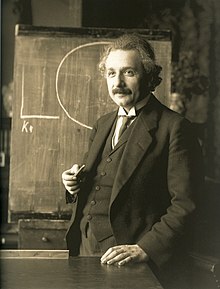
A man was staring out into space, contemplating. What was he thinking? He envisioned himself riding on a beam of light, and time stopping in its tracks. Who was this man? His name was Albert Einstein.
Almost everyone knows who Einstein was. He was a scientist who came up with a lot of complicated theories like E=MC2. But what exactly did he say? And where did Einstein really come from? And what on earth does E=MC2 mean? How much do you really know about Albert Einstein? Today, let us examine this man who left such a large watermark on history, by looking at his early life, his ‘magic year’ when he wrote his most famous papers, and finally at his life during World War Two and his death..
Einstein was a Jew born in Ulm, Germany in 1879. His family later moved to Munich, and then to Italy. Einstein finally went to Switzerland, where, in 1896, he trained to be a teacher in science and mathematics. In 1901, Einstein acquired Swiss citizenship but was unable to find a teaching post; eventually he accepted a position as technical assistant in the Swiss Patent Office. And finally in 1904, Einstein spent his last year of being unknown. He was poor, underemployed, and rejected by Europe’s academic establishment. But that was all about to change.
1905 was Einstein’s ‘miracle year’. It was the year in which he published his most famous papers on science. The first was published on March the seventeenth and was entitled ‘On a heuristic viewpoint concerning the production and transformation of light’. The paper explained the photoelectric effect by proposing that light existed as what he called ‘quanta’. We now call light quanta photons; basically photons are units of light. In April, Einstein worked out the theory of ‘special relativity’. Special Relativity deals with many complex topics but some of the more well known points that Einstein made were that if an object moved faster than the speed of light, it would travel backwards through time, and his most famous idea ever, E=MC2. Since the later is so mysterious, it might be helpful to explain it. E means energy, M means matter, and C means the speed of light in a vacuum. The short explanation to the equation is that a small amount of matter, (e.g. A metal, a solid, a liquid, or a gas) is equal to a large amount of energy. The equation has been used in nuclear bombs or reactors where matter is turned into energy producing nuclear energy or a nuclear blast. The third paper dealt with ‘Brownian Motion’ or the seemingly random movement of particles in a gas or liquid. Just for his paper on the photoelectric effect, Einstein won the Nobel Prize in Physics.
Right before the Second World War, Einstein’s belongings were seized by the Nazi Party because he was Jewish. Einstein fled from Germany to the United States and continued his work there. In 1938 he feared that Germany might be developing nuclear weapons and he advised President Roosevelt to begin creating the atomic bomb using his theory of E=MC2. This led to the two bombs that were dropped on Japan at the end of the war. Einstein became an American citizen and lived in America even after the war. Einstein’s studies on things like electricity have been used in any of the inventions, which use those concepts, like microwave ovens. He continued to study and theorize in physics until he died at the age of 76.
Albert Einstein was one of the greatest scientists of the twentieth century. From the photoelectric effect, to E=MC2, Einstein’s work allowed us to have many of the devices we use today. And now I hope that you know more about the man who left such a large watermark on history.
The man thought about what would happen if he could ride on a beam of light. Could time stop? He took out a piece of paper and scribbled some notes down onto it. He started with ‘special relativity’. A good name for the theory.